Disney Frozen Royal Castle
- 4.2
- Rating
- 10.00M
- Installs
- Free
- Price

 Analysis by App-foxy
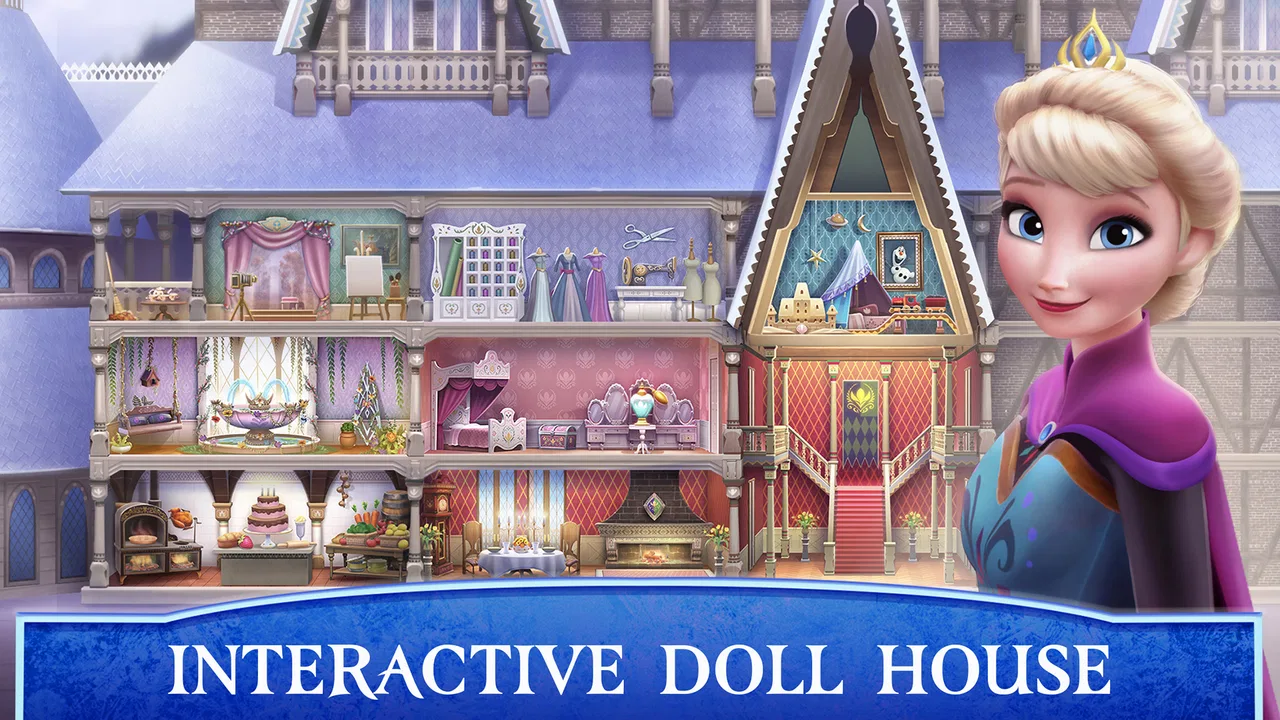
Disney Frozen Royal Castle is the kind of simulation game I would hand to a child who enjoys arranging rooms, changing outfits, and making up small stories with familiar characters. I spent time looking at it less as a quick Frozen tie-in and more as an interactive dollhouse, because that is where its appeal really sits. You are not chasing a difficult score or learning a complicated strategy system; you are creating little scenes with Elsa, Anna, and the castle around them.
That makes it an easy recommendation for some families, but not for everyone. The experience is aimed at relaxed, imaginative play, and its strongest quality is the freedom to decide what happens next. At the same time, a child looking for a deeper adventure, a demanding simulation, or a large variety of activities may reach its limits fairly quickly. My overall impression is warm, with an important qualification: the game works best when the goal is accessible pretend play rather than long-term challenge.
How the castle feels to explore and understand
The basic idea is immediately familiar. Instead of presenting a long tutorial or a complicated menu system, the game places the player in a Frozen-themed castle where characters, clothing, and rooms become the materials for play. That setup is helpful for children who understand games through pictures and direct interaction rather than through extensive reading.
You May Also Like

 Blood Strike: 2.5 Anniversary
Blood Strike’s Loadouts Turn Every Drop Into a Tactical Gamble
A close look at Blood Strike’s custom loadouts: how fast access to signature weapons reshapes its battle royale rhythm, rewards preparation, and narrows the gap between fights.

 Pandora - Music & Podcasts
Pandora’s Music Is Easy to Start, but Harder to Recover
Pandora’s strength is its low-effort path from a seed to a station. Its weak spot is how much confidence it asks you to place in connection, setup, and quiet recovery.

 8 Ball Pool
 Is Built on Rivalries, Rematches, and Routine
A close look at the rivalries, rematches, shared routines, and unanswered safety questions that turn a quick pool match into a persistent mobile community.

 Samsung Music
’s Quiet Strength Is Playing What You Already Own
Its reach comes less from spectacle than from dependable access to a personal library. That simplicity is both the app’s strongest retention engine and its ceiling.

 AccuWeather: Weather Radar
AccuWeather Review: A Quick, Clear Forecast for Everyday Decisions
For everyday plans, the best forecast is the one you can understand quickly. AccuWeather makes rain timing, radar, and local conditions easy to act on, with a few trade-offs.

 Hill Climb Racing
Why Hill Climb Racing Still Turns Crashes Into One More Run
A tiny car, a bumpy hill and one more upgrade: Hill Climb Racing keeps resurfacing because its simple chaos makes every near-miss feel personal.
More From Our News Desk



In my experience, the recognizable setting does a lot of the orientation work. Elsa and Anna give the child clear points of reference, while the castle provides a visual sense of place. A young player can usually understand the difference between choosing a character, changing an outfit, and interacting with an object simply by experimenting. That is a more welcoming approach than a simulation game built around dense text panels and layered management screens.
Readability is not only about the size of words. It is also about whether the screen communicates what matters first. Here, the visual theme carries much of the meaning, which can support children who are still developing reading confidence. Parents should still sit with a child during the first session, especially if the child is unfamiliar with touch games. A brief shared exploration can show where to tap and how to move between parts of the castle without turning the game into a lesson.
The navigation also suits short play sessions. A child can open the game, create a scene, and stop without needing to remember a complicated chain of objectives. That is useful on a quiet afternoon, during a waiting period, or when a parent wants an activity that can be picked up without much preparation. The game does not demand the same mental commitment as a large building simulator or an adventure with a long quest line.
There is a trade-off in this simplicity. Children who like clear goals may wonder what they are supposed to accomplish after the initial excitement of exploring. The castle is more of a stage than a traditional level-based game. I would explain that to a child before downloading it: the reward comes from dressing characters and inventing situations, not from unlocking a sequence of difficult missions.
Why the dollhouse format helps different players
The dollhouse structure is particularly useful for children who prefer open-ended play. There is no single correct story, so a child can repeat the same activity in different ways. Elsa can be prepared for a royal event, Anna can be placed in a quiet room, or both can become part of an entirely invented scene. This flexibility gives the player room to choose the pace and complexity of the session.
It can also make shared play easier. One child may choose outfits while another decides where the characters should go. A parent can join without needing to master a ruleset, and a sibling who is less interested in competition can still contribute. That is one of the more valuable aspects of this particular format: participation does not depend on being the fastest or most accurate player.
For a child who benefits from predictable routines, I found it practical to use the same small sequence each time: enter the castle, choose a character, select clothing, then act out a short story. This is not a special mode in the game; it is a way of organizing play around its existing elements. The routine reduces the pressure to invent everything from scratch and can make the experience feel more manageable.
The game is listed for Everyone, which matches its gentle presentation and family-oriented premise. I would still make the final decision based on the individual child, because age labels cannot describe every child’s tolerance for animation, touch controls, or in-app purchase prompts. The rating is a useful starting point, not a substitute for supervision.
Touch control, movement, and sensory comfort
Touch interaction is approachable, but it is not automatically comfortable for every player. A child with limited fine-motor control may find repeated tapping, dragging, or selecting small visual targets tiring, even when the game itself feels simple. For that reason, I would test it alongside the child rather than assuming that a familiar character makes every action easy.
A helpful approach is to let the child make the creative decisions while an adult handles any awkward touch actions. That keeps the child in control of the story without making motor precision the barrier to participation. It also works well for younger players who know what they want Elsa or Anna to wear but are still learning how to navigate a touchscreen.
The visual presentation is bright and strongly themed around Frozen. That will be part of the attraction for fans, but it may be tiring for children who are sensitive to busy scenes or repeated visual effects. I would use shorter sessions and lower surrounding distractions if the child becomes uncomfortable. Playing in a calm room, keeping the device at a comfortable distance, and taking breaks are sensible habits even when the game is being used casually.
Sound is another consideration for shared spaces. A child may enjoy the atmosphere, while a parent working nearby may prefer quieter play. I would keep the device volume low at first and check whether the child can follow the activity without relying on loud audio. This is also useful in places such as a doctor’s waiting room, where silent or nearly silent play is more considerate.
One practical strength is that the game does not require a child to compete against another player in order to enjoy it. A player who needs more time can remain in the same creative space rather than being eliminated or left behind. That makes it more suitable for mixed-ability family play than a fast competitive game. However, the absence of competition does not remove every challenge: navigating touch targets and understanding the available choices can still require support.
Using it in real family situations
I can imagine this game working well during a rainy afternoon when a child wants something connected to a favorite film but is not ready for a full-length movie. A parent can sit nearby, ask the child to describe what is happening in the castle, and turn the outfit and room choices into a short storytelling exercise. The game becomes more engaging when it is treated as a prompt for conversation rather than as a passive screen activity.
It is also suited to brief transitions. If a child needs a calm activity while waiting for an appointment or while a meal is being prepared, the open-ended format means there is no urgent mission to abandon. I would avoid promising a completely interruption-proof experience, though. Any game with touch interactions can be frustrating if a child has to stop in the middle of choosing something or if a younger player loses track of what they were doing.
For travel, the main question is not whether the theme is appealing but whether the child already understands the controls. I would introduce it at home first, when an adult has time to help. That small step matters because a new game can create more frustration than entertainment when a family is already dealing with noise, limited space, or a tight schedule.
The game may also support imaginative language. A parent can ask, “What is Anna doing in this room?” or “Why did Elsa choose that outfit?” Those questions turn simple customization into practice with sequencing, description, and pretend dialogue. I would not present it as an educational tool in itself, but it can become a useful shared activity when an adult adds conversation.
What may still get in the way
The biggest limitation is the same feature that makes the game approachable: it is deliberately light. Players who expect a story-driven adventure, puzzles, construction depth, or a large progression system may find the experience shallow. Compared with a traditional simulation game, it offers less pressure and less complexity. Compared with a dedicated dress-up game, its appeal is more strongly tied to the Frozen setting and castle environment.
That comparison helps clarify who should choose it. If a child wants to control familiar characters and create scenes, this is a natural fit. If the child mainly wants racing, combat, resource management, or a clear campaign, another category would be better. I would also skip it for a player who quickly loses interest in repeating creative activities without new objectives.
The free price makes trying it easier, but families should pay attention to the purchase structure. The game includes in-app purchases priced at $9.99 per item. That is a meaningful consideration when a child is playing independently. I would review the purchase settings on the device and establish a simple rule before handing it over: choosing an outfit is part of the game, but buying anything requires an adult. This conversation is more useful than treating the free download as if it carried no spending risk.
Another possible barrier is attention span. Open-ended play can be calming for one child and aimless for another. If the player keeps asking what to do next, I would provide a small challenge from outside the game, such as creating a scene for a birthday, a winter morning, or a royal meeting. That gives structure without pretending the game has objectives it does not actually offer.
Parents should also think about independence. A child who reads confidently and already understands touch interfaces may explore comfortably alone. A child with motor, language, visual, or attention-related needs may benefit from an adult nearby. The game can be shared and adapted, but it should not be described as universally effortless. Inclusive play often depends as much on the setup and the people around the player as on the app itself.
Performance, value, and the right audience
Disney Frozen Royal Castle comes from Budge Studios and is available as a free game in the simulation category. It has reached over ten million installs and holds an average rating of 4.1 from around thirty-five thousand ratings, with several hundred written reviews. Those figures suggest that the concept has found a substantial audience, although popularity alone does not guarantee that it will suit a child who wants more depth.
The current version is 2026.1.0, and it requires Android 5.1 or later. That makes it accessible to families using a range of Android devices, though the experience can still vary depending on screen size, touch responsiveness, and how comfortably a child can see the castle. On a smaller phone, shared play may feel cramped; a larger screen is more practical when an adult and child are looking together.
Because the game is free to start, I see it as a low-commitment way to test whether a child likes this style of play. The better value comes when the child returns to it for storytelling and customization rather than playing once because of the Frozen name. If the interest disappears after the first exploration, the free entry point limits the disappointment, provided the family has kept purchases under control.
Compared with a conventional dollhouse game, the recognizable characters and castle give children an immediate imaginative framework. Compared with a more ambitious simulation, it removes much of the planning and management that can be rewarding for older players. Compared with a linear Frozen story, it gives the child more control but less narrative direction. I would choose it specifically for that middle ground: familiar characters, simple interaction, and self-directed scenes.
My inclusive verdict
After using it as a family-style simulation rather than judging it by the standards of an action game, I think Disney Frozen Royal Castle is a welcoming choice for children who enjoy dress-up and pretend play. Its visual familiarity can make the first steps less intimidating, and its open format lets players participate at their own speed. It is especially promising for shared sessions where an adult or sibling can help with touch actions and turn the castle into a storytelling space.
Its accessibility has limits. Bright presentation, touchscreen precision, changing visual choices, and purchase prompts may require practical support. The game also offers little for a child who needs challenging objectives or a strong sense of progression. I would therefore recommend trying it with the intended player, watching how they handle navigation and sensory stimulation, and setting purchase boundaries before independent use.
For the right child, the lack of pressure is a genuine strength. There is room to pause, repeat a favorite scene, change an outfit, or invent a new reason for Elsa and Anna to be together. For the wrong child, that same freedom may feel empty. My final recommendation is positive but specific: choose it for gentle Frozen-themed creative play, not as a replacement for a deeper simulation or a structured adventure.
FAQs for Disney Frozen Royal Castle
01What is Disney Frozen Royal Castle about?
Disney Frozen Royal Castle is an interactive game where players can explore the magical world of Arendelle. You get to join beloved characters like Elsa, Anna, and Olaf on various adventures. The game emphasizes creativity and problem-solving as players decorate the castle, complete quests, and engage in fun mini-games.
02Is Disney Frozen Royal Castle suitable for all ages?
Yes, Disney Frozen Royal Castle is designed to be family-friendly and suitable for players of all ages. Its easy-to-navigate interface and engaging gameplay are perfect for children, while the enchanting storyline and stunning graphics appeal to older fans of the Frozen franchise as well.
03Are there in-app purchases in Disney Frozen Royal Castle?
Yes, Disney Frozen Royal Castle offers in-app purchases. While the game is free to download and play, certain items, decorations, and features may require real money to unlock. Parents are advised to manage in-app purchases through device settings to avoid unexpected charges.
04Does Disney Frozen Royal Castle require an internet connection?
Disney Frozen Royal Castle does not require a constant internet connection to play. However, certain features, such as downloading updates or accessing online content, may require connectivity. It's best to have an internet connection available for a complete experience.
05What devices are compatible with Disney Frozen Royal Castle?
Disney Frozen Royal Castle is available on both Android and iOS platforms. It requires Android 5.0 or later and iOS 10.0 or later. Ensure your device meets these specifications for optimal gameplay, as older devices may experience performance issues.
Pros
- Stunning graphics bring Arendelle to life.
- Engaging puzzles keep players entertained.
- Interactive features enhance storytelling.
- Suitable for kids and family play.
- Frequent updates with new content.
Cons
- Limited character selection options.
- In-app purchases can add up quickly.
- Requires a stable internet connection.
- Some features locked behind paywalls.
- Occasional lag on older devices.

Disney Frozen Royal Castle
Gallery